Drills, Skills and Articles

Browse the site for some of the best drills, skills and articles related to Inline/Roller hockey.

Submit your favorite drill

We want to see your best drill. Submit it for all to see.

Connect with us

Make sure you follow us on Twitter and 'Like' our Facebook page to keep up to date with all the latest information.

Draw up your own drills

Download a blank rink to help draw up your own drills and build your practice plans.

HockeyShare Online Drill Diagrammer & Practice Planner

Wednesday, September 28, 2011

Puck Retrieval - Breakout setup

Drill:
1. X1 picks up puck behind net and decides which way to go with the puck
2. X3 (a defenseman) must get to the front of the net
3. X2 & X4 must read X1 and adjust their location accordingly
4. X1 moves the puck up and all players breakout of the zone

Focus:
1. Players keeping in their lanes and maintaining position
2. Head up skating to know where the puck and/or open player is
3. Moving the puck out of the zone

Notes:
You can add in a forechecker to put pressure on the puck carrier

Related Drills:
3 on 2 Breakout 
Behind the Net Breakout 

1-1 Sprints (Half Rink)

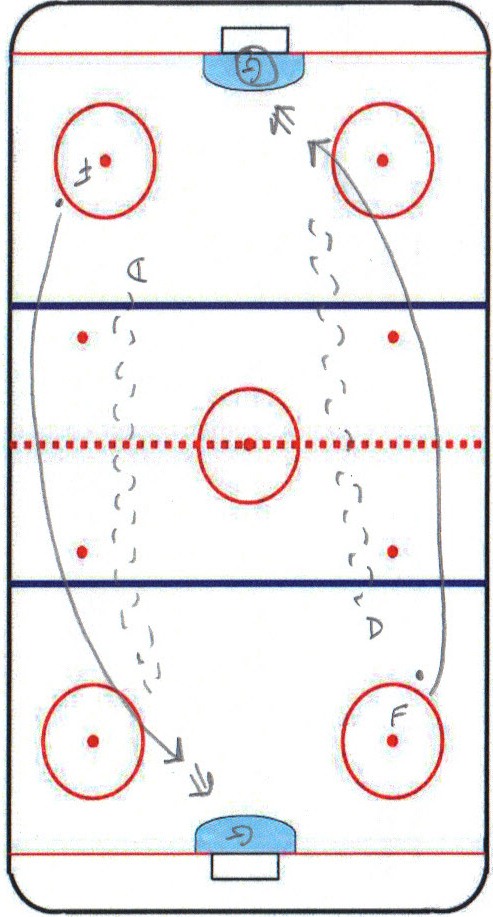
Drill:
1. On whistle, Defense starts skating backward and Offense carries the puck in the zone
2. Offense tries to beat the D down the wall
3. Defense tries to cut off O and steal the puck

Focus:
1. Defense needs to realize when to make move and push player outside
2. Offense needs to read defense and make play accordingly.
- If D goes toward the wall, cut it inside.
- If D leaves outside open, use speed to get around.

Notes:
This is a good drill to help the Defense better understand when they are going to get beat and transition from backward to forward quickly enough to not allow the player to go around them.

Related Drills:
1 on1 Sprints (Half Rink) 
1 on 1 Half Rink 

Tuesday, September 20, 2011

2 on 1 Corner Dump

Drill:
1. Line up 2 player against a Coach
2. Player dumps puck to corner and chases
3. Player 1 chases puck and Player 2 follows
4. Player 1 picks up puck and skate up the wall
5. As player 1 comes up the boards, they drop the pass back to Player 2
6. Player 1 continues around the circle and cuts to the net and gets a return pass and shoots on goal
7. Coach should simply help drive the player outside to help them understand how to get position
8. Run from each side

Focus:

1. Players work on skating to win a corner battle
2. Picking up a loose puck and then driving the net
3. Players work on passing and getting to the open spot for a return pass

Notes:

Related Drills:
1 on 1 Corner Dump
Tight Turns out of the Corner 

1 on 1 Corner Dump

Drill:
1. Line up 1 player against a Coach
2. Player dumps puck to corner and chases
3. Pick up puck and skate around the cone and drive the net
4. Coach should simply help drive the player outside to help them understand how to get position
5. Run from each side

Focus:
1. Players work on skating to win a corner battle
2. Picking up a loose puck and then driving the net

Notes:

Related Drills:
2 on 1 Corner Dump

1 on 1 Sprints

Drill:
1. Line up 1 D at the blue line
2. Line up 1 F at the top of the circle
3. On the whistle, D breaks backwards, F skates forward with the puck trying to beat the D

Focus:
1. Forwards concentrate on beating the D
2. Defense works on quick backward starts and then transitioning when the time is right so they don’t get beat

Notes:
Good full length drill to get the kids skating.

Related Drills:
Windmills
Russian Suicides II (The Admiral II)

4 on 2 Forecheck

Drill:
1. Line up 4 players at the blue line
2. Line up 2 coaches near the goal line
3. Have one of the Forwards dump the puck into the corner and each forward covers a Coach
4. Coaches work to get the puck out of the zone
5. Forecheckers work to get the puck and then set up a play in the Offensive zone.

Focus:

1. Forwards concentrate on getting to the pucks and working along the boards to gain position
2. Defense works on holding the point and keeping the puck in

Notes:
Start with coaches so they focus is on gaining puck control and then setting up the play.
Add players at a later time so they can focus on working the puck up the boards.
Have them make XX number of passes before shooting.

Related Drills:
Dump and chase

Friday, September 16, 2011

Windmills

Drill:
1. Line players up in opposite corners
2. Place a coach at each wall on the blue lines (4 coaches)
3. Players start by making a pass to the opposite side of the blue and the skate the middle
4. Player receives return pass and passes to the next blue line (again opposite side from where they started)
5. Player receives pass and then skates in on net

Focus:
1. Hard passes
2. Head up play as there is another player coming the other way
3. Receiving and making good passes

Notes:
Replace coaches with players so they can work on their give and go passes.
Thanks to Nino Febbraro for this drill.

Related Drills:
Russian Sucides II (The Admiral II)
Russian Suicides (The Admiral)

Goalie – 3 Shot Drill

Drill:
1. Player skates down from wing and shoots
2. Player on opposite side gives the goalie a chance to recover then skates in and shoots
3. Coach lets the goalie recover then tries to stuff a puck in the net

Focus:
1. Players should focus on skating hard to the net and shooting. Shots should wrist or slapshots
2. Focus on Goalie movement from side to side, playing angles and recovering
3. Players should not try to make dekes or trick shots

Notes:
You can sub a player for the coach so they can work on their close range shots
You want a quick pace for the goalies. Give them enough time to recover but not a lot. This drill helps with their quickness and stamina.

Related Drills:
3 Shot Drill Variation
Goalie Warm Up

Russian Suicides II (The Admiral II)

Drill:
1. Player 1 skates to the other end around the cone
2. Player 2 in other corner passes to Player 1 and then backchecks
3. After Player 1 shoots, Player 2 skates around the other cone and drill continues

Focus:
1. Hard skating
2. Stickhandling and shooting
3. Quick transition from Offense to Defense
4. Chasing down a player from behind

Notes:
This is a great drill to get the kids going on a slow night. It really focuses on skating, stickhandling and shooting as quickly as possible.

Related Drills:
Russian Suicides
Windmills

Tuesday, September 13, 2011

2 on 1 - Pass to D (Half rink)

Drill:
1. On the whistle D1 at the Blue line skates backward toward mid rink and looks for a pass from Forward 1
2. Forward 1 skates with a puck above the circle and passes out to D1 and then continues outside the blue line looking for a return pass
3. D2 skates toward the blue line and will transition and play D when F1 gets the return pass
4. F1 gets the puck and tries to beat D2 one on one
5. F1 has the option to drop the pass to D1 (who should be trailing the play)

Focus:
1. Forward should make a good pass to the Defense
2. Defense works to make a good pass to the Forward entering the zone
3. Defense 2 should work on good positioning and pushing the Forward outside and away from the net

Notes:
You could also run this drill from Center but I like the skating and movement of the drill. There will be times when the only option is to move the puck to a D and then re-enter the zone. This will teach them to keep moving and get open for the return pass.

Tuesday, September 6, 2011

5 Lessons Every Hockey Parent Should Follow

Thanks to Rich Taylor over at Youth Hockey Review for letting me repost this great article.

As another youth hockey season begins I’d like to provide parents with a brief guide to help make this a great year.
These suggestions are intended to help us keep one key point in mind – youth hockey should be fun.
In our love for our kids, and desire to see them develop, many of us (myself included at times) forget that there are more important lessons at stake here than simply learning how to skate, pass and shoot.
Hockey is a fun game for many reasons. But the fun can quickly be lost when parents loose perspective, and common sense, about what the game is really about – teamwork.
So here are 5 common sense lessons that every hockey parent should keep in mind to make this, and every, hockey season more rewarding.
1.    Hockey is a team game. Every team will have some players who are better than others, but team success depends on everyone learning to work together – in practices and in games. No individual, no matter how skilled, has lasting success in a team sport without learning to work as part of a team.
As parents, you’re part of the team too. It’s your role and responsibility to work together – with the coaches, the other parents and the club. If you focus your attention solely on your child and his or her individual needs, you won’t be setting a good example – and your child probably won’t learn the full value of teamwork.
2.   Let the Coach – Coach. Stop yelling instructions down from the stands or boards. Most of the time the kids can’t hear you anyway. You may not always agree with the coach, but you should respect their responsibility for leading the team. Sometimes their decisions will seem hard to understand – or in fact could be a mistake. Coaches make mistakes too. But when your child is always looking to you to make sure they’re doing the things you want them too – they’re not listening to the coach.
If you don’t feel comfortable with your coach’s approach to practices and games, sit down and talk. Most coaches will welcome suggestions and input at the right time. But when you teach your child that he or she should focus and do what you say – because you’re the parent – you’re teaching him or her to disrespect the coach and that individual needs are more important than teamwork.
3.   Be an example. Teamwork starts by being on time. Yes we’re all busy. You have other kids to care for and other places to be. But the time before your child steps on the ice is important. It provides valuable time to bond with other players, and the coaching staff.
When your child is consistently the last one to practice, or gets to games just in time – but misses the coaches talk or warm ups – you’re sending the message that you and your family’s individual issues matter more than the team. That’s simply not fair to everyone else. Life happens, so when you can’t be on time, for whatever reason, at least shoot the coaches an email, phone call or text. By being a good example, and demonstrating you value your commitments to others, your son or daughter will learn to keep in mind how his or her actions affect others.
4.   Kill the negativity. Your child may not always get equal ice time. Sometimes shifts run long. Young players don’t always listen to the coaches when they call for a change. Other times the coach may mix of lines or short-shift a line to try and capitalize on an opportunity. Maybe your child is playing a great game, when all of the sudden the coach sits him or her down to play another player who isn’t as skilled. The team might lose a game it should have won.
As soon as you begin creating your list of “that’s not fair” you’re poisoning the water and showing disrespect for the coach, the team, and ultimately yourself. If you have a fair and good point about something you’ve seen that concerns you – raise it at the appropriate time and take it up directly with the coach. But don’t expect him to agree with you or your point of view (or else).
It’s not constructive, or fun, to have a negative voice constantly raising concerns or frustrations. While most parent intentions are to help, many times their actions are in fact unhelpful. So the next time something hockey related gets you upset, think before you act. Try reframing the conversation and taking a more positive approach. You’ll be a better role model for teaching your child how to deal with challenges and adversity when they see you acting in a more positive manner.
5.   Create a success journal. Talk to your child about the season to understand his or her goals. What’s really important to him or her from their perspective? Write it down. Then add a few key points and lessons that you as a parent feel are important. When finished, discuss your goals and expectations with the coach.
Watch the action in games and practices – not just your child, but the overall teamwork and development as a group. In school your child follows a lesson plan, gets homework, and is periodically reviewed. A hockey journal is a terrific and simple way to apply the same kind of practical, systematic and constructive feedback to help you, your child and even the coaches make the season as fun as possible while developing and improving every step of the way.
Travel hockey is a big commitment – we invest a lot of time, money, energy and resources in the belief that it’s good for your kids. So let’s make sure it is good for our kids. Let’s remember our responsibility as parents to teach them the lesson of teamwork – whether we’re on the ice or off it. It’s a critically important factor for success in hockey – and in life.

Related Posts:
Letter to parents

Monday, August 29, 2011

Behind the Net Breakout

Drill:
1. Players work together as a team to bring the puck out of the zone
2. 1 Defensemen gets the puck behind the net to start the play
3. The other Defenseman has to hold his ground in front of the net
4. The 2 Forward will come down along the boards to the tops of the circles and cut back up.
5. Forward takes pass and they move it out
6. D in front of net joins the rush and the other is the last guy in the zone

Focus:
1. If they have time, the D can stop and set up the play
2. If they don’t they have to skate with the puck and make a good outlet pass
3. Forwards have to focus on where they need to be. If they do not get the pass, they should move toward the middle of the rink to cut the next pass length down

Notes:
This drill really focuses on getting the puck out of their own end. Players learn to make decisions on whether to carry the puck or pass.
Add a coach in as a fore-checker after they get used to it.
You could also start to add your own forwards into the play as well to work on their fore-checking skills.

Related Drills:
3 on 2 breakout
2 on 0 breakout

2 Man Long Outlet Pass

Drill:
1. On whistle Forward closest to the wall skate out toward the blue line and then across the rink
2. Player with the puck starts skating toward the blue line and looks for the Forward skating along the far blue line and makes pass
3. Player then follows the pass and drives toward the net

Focus:
1. Long outlet passes to the far blue line
2. Lateral movement along the blue line looking for pass
3. Entrance into the zone

Notes:
You can mix this up and add a Defenseman to defend against the long pass

Related Drills:
2 on 1 pass and go 
Shoot and break 

Friday, August 26, 2011

3-0 Drop and Crash

Drill:
1. Forward 1 carries puck into the zone, Forward 2 drives the net, Defenseman 1 is trailing the play
2. Forward 1 drops the puck to D1 and Forward 1 continues toward the net
3. D1 has 2 options:
    - Shoot on net with a low shot looking for a deflection from Forward 1 or 2
    - Pass to Forward 2 who should be coming in the back side of the goalie
4. Forwards look for rebound or chase loose pucks to the corner

Focus:
1. Get Defense involved
2. Drive the net and look for rebounds/deflections

Notes:
After you have run this several times, introduce 1 or 2 Defense to play against the 3 man team. You can also add a 4th player to the Offensive team.

Related Drills:
2 on 0 give and go
Cross overs enter zone

Wednesday, August 24, 2011

2 on 1 Breakout

Drill:
1. On whistle, the Forwards in the each corner skate for the opposite dot, turn and cut back in the middle. Defense starts to skate backward out of the zone.
2. Goalie (or a Coach) looks to make an outlet pass to one of the players after they turn the dot
3. 2 Forwards now work out of the zone and Defense works to control their movement

Focus:
1. Lateral movement by the Forwards to get open
2. Puck movement by the Goalie. Goalie should focus on passes out toward the circles and not in the middle

Notes:
This drill is move for skating and lateral movement and is not recommended as a breakout option. Skating back and forth is wasted movement and moving the puck in front of the net is never a good thing.  What I'm trying to teach them is the side to side movement to get open.  Most young players want to head straight up the rink.

Related Drills:
3 on 2 breakout
Behind net breakout

Friday, August 19, 2011

Skate 8 and Deflect

Drill:
1. Line 3 Defenseman up at the points (D location is based on skill level of players and how far they can shoot.
2. Forward passes puck to point man and skates around first circle and then stops in front of net looking for a deflection from the D shooting from the top of the circle he just skated around.
3. Forward now skates toward the corner, picks up a puck and passes it to the point man. He continues around the circle to the front of the net again looking for a deflection
4. Last he moves toward the middle of the net looking for a deflection from the last Defenseman.

Focus:
1. Puck movement to the Point man.
2. Getting to the front of the net and looking for deflections/rebounds.

Notes:
I found a variation of this drill on another site and will give credit if I can locate it again.

Related Drills:
Drop and go
Skate and tip

Tuesday, August 16, 2011

Skate, Stop and Pass

Drill:
1. Put players in groups of 2 starting at the goal line
2. Player 1 skates 4 strides, stops and looks for a pass from Player 2
3. Player 2 passes back to Player 2, then skates stops and looks for a pass
4. Continue this to the Blue line
5. Repeat all the way back to the goal line
6. Player 1 & 2 Switch positions and repeat drill

Focus:
1. Good quick starts
2. Good Stops and head up looking for a pass
3. Good passes back to their teammate

Notes:
A lot of variations on this drill by changing up the number of strides or placing markers where they need to stop.

Related Drills:
Passing Forward/backward Tandems
Give and Go

Monday, August 15, 2011

Iron Cross

Drill:
  1. Players start at the bottom of the circle and skate to the top
  2. Then they skate backward to the side of the circle
  3. Next they do side-steps to the other side of the circle
  4. Then backwards to the bottom of the other circle
  5. Skate to other circle and repeat

Focus:
  1. Skating footwork and speed
  2. Focuses on movement in all directions which will only help them in their game

Notes:
This will improve their footwork and speed over time.
If you have the full rink, use all 5 circles.

Friday, August 12, 2011

How to Make a Hockey Equipment Tree

Are you looking for a great way to store your Hockey Gear? Getting it out of the bag alone will help with the smell that we've all come to love/hate, but hanging it up and letting it air out, will really help control the odor and growth of bacteria.

Thanks to Mike over at Hockey University for letting me share this. He has a great article on how to build a Hockey equipment tree. If you are interested in making what you see in the pictures below, read the instructions here.

Friday, July 29, 2011

Top 10 things you can do to help grow IHD

So now that IHD is 1 year old, what can you do to help?
  1. Submit a Drill - Share your favorite drills with us.
  2. Follow IHD on Twitter - Join the conversation and help spread the drills.
  3. Like IHD on Facebook  - Share this page with all your friends who love hockey.
  4. Join the Forums and share your knowledge.
  5. Click on the Sponsor links on the top and right side of the page.  Find something you like and buy it.
  6. Provide feedback on the drills. If you used the drill and modified it, let us know how you changed it and how it worked out.
  7. Provide feedback on the site.  What is it missing or what else would you like to see.
  8. Share a resource that you use.  Let us know what other sites you go to talk or learn hockey.
  9. Provide a coaching tip.  Not necessarily a drill, but one thing that you think all coaches need to do to be better for their players, parents and the game of hockey.
  10. Keep coming back and viewing the site!!